
Difficulties are an inevitable part of relationships
It’s been said, “If it weren’t for the people our jobs would be fun!” Some days it sure feels that way. Regardless of the nature of our relationships (family, friend, client, employee, boss, etc.) there will be times when the other person in the relationship will say or do something that will have a negative impact on us. Examples include: our child doesn’t finish their homework or chores, a client cancels an appointment or is late paying a bill, an employee is late for work or doesn’t show up at all, our spouse makes a commitment for us without checking with us first, etc. Sometimes these are deliberate acts. Mostly though these are spontaneous actions/choices or actions whose consequences haven’t been thoughtfully considered. No harm was intended. Regardless of the intention the result is: frustration/upset/hurt/preoccupation.
There is a solution
This article will explore ways to prevent/minimize relationship difficulties and what to do when face-to-face with unacceptable/irritating behaviors from others. A key to harmonious relationships is decisive action when problems emerge. Left unattended these “relationship potholes” inevitably worsen and can “spillover” to other relationships. (Frustrations/problems from the workplace get brought home and vice-versa.) Fortunately there is a host of possible actions to take that can get things back on track. They vary based on the severity and/or frequency of the problem; and the strength or importance of the relationship.
Whose problem is it?
When we become upset or preoccupied by another’s words or actions it is our problem. The other’s behavior precipitated our reaction, but is our problem. Establishing proper “ownership” of the problem is critical because it dictates who’s responsible for solving it – we are.
Our first reaction is generally along the lines of, “Why did this person do/say this?” Most of the time people are oblivious to the consequences of their actions. Unfortunately, unless we offer feedback about the impact of their actions they will generally remain oblivious. Because it is our problem we have to provide that feedback. If we don’t the problem behavior is likely to continue. The good news is, when we do provide the feedback a number of positive things happen. We are better understood, we often prevent future difficulties and we promote openness in others. Most importantly, we feel better about ourselves.
Prescribe the right medication
There are 3 different responses to unacceptable/irritating behavior: Accept, Change self, Change the other person. These variables allow the mode of treatment to match the problem.
Acceptance
The least stressful and easiest choice is to accept the annoying behavior. Sometimes we make mountains out of mole hills. If a behavior is more of a mild irritation than a legitimate issue or problem it may be best to just let it go. Life is a lot smoother if we learn tolerance. The challenge is to really let go. Our tendency is to keep score. Instead of accepting – we stuff. We get annoyed with another’s actions but we don’t provide any feedback. We don’t forget about it either. It becomes resentment. It will inevitably grow over time; and, if we stuff enough garbage the bag will eventually break. This buildup of resentment will usually lead to an eruption of emotion that is generally counter productive. Resentment is a poison that you consume that is intended for someone else. The best thing to do is let little annoyances go – forget about them.
Look in the Mirror
Sometimes undesired behaviors occur as a result of something we have said or done. As difficult as that may seem, sometimes we are our own worst enemy. It’s quite possible that our behavior has actually led to actions/response in others. Here’s an example. If our track record of punctuality is poor over time this behavior communicates to others that timeliness is not important to us. Then suppose there is an event where punctuality is important to you but the other person is late. Before you get mad and/or provide corrective feedback you may have to consider if you played any part in this difficulty. Because of your track record the other person may have assumed the deadline or time frame was only an estimate not a fixed point in time.
Another example is if we get short or upset when others bring us unpleasant news (shooting the messenger). In the future they may withhold vital information for which we’ll become even more upset. Unfortunately, it was our own behavior that led to this situation. Try to become more aware of how your behaviors impact those around you. You may find that slight modifications to your actions can greatly improve the actions of others.
Modifying others behavior
Actually it is impossible to change other people. They have to change themselves. Fortunately, we can provide data (feedback) that may encourage them to want to make appropriate changes. Depending on the severity of the problem and/or the strength of your relationship you’ll need to try different caliber approaches. Sometimes a simple explanation of your feelings may get the job done. Other times you’ll need to resort to serious confrontation. In a limited number of cases you may actually want to end a relationship.
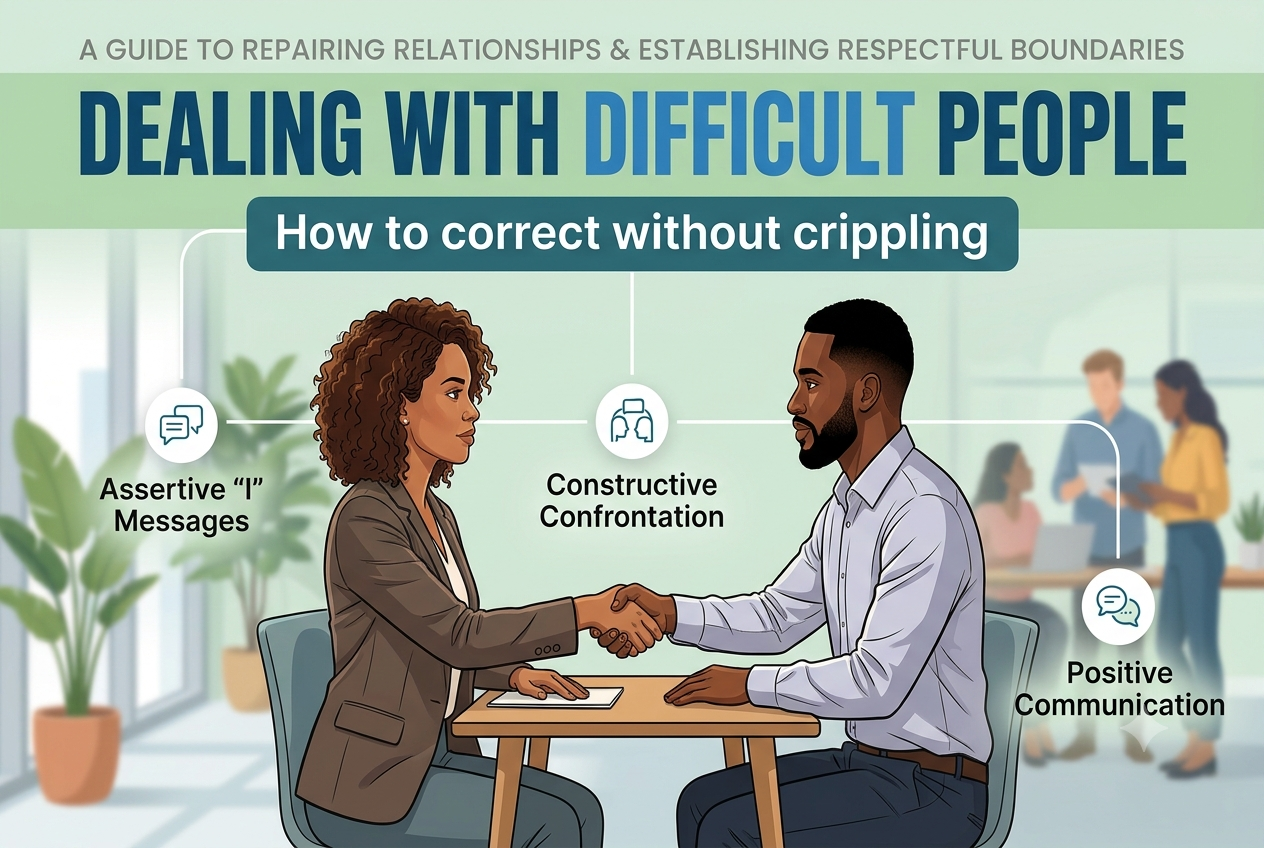
Assertive “I” Messages
When we experience a problem with another person’s behavior, are fairly certain we cannot accept the behavior and/or didn’t cause the problem by our own actions, it’s time to assert ourselves. Assertiveness is an honest expression of your needs, wants, feelings, beliefs, etc. It is non-blameful, non-critical, non-threatening. It exposes the real you. It allows you to make others aware of how you feel and/or what you think. It lets others see the world through your eyes. This is in contrast to aggressiveness which is a manipulative attempt to control others. Huge difference.
We assert ourselves through the use of “I” messages. This places the ownership of the issue with us. There are 3 versions of “I” messages: Declarative, Preventive and Responsive. They all use the same formula. A statement of what you think or feel followed by an explanation of why you think or feel that way (“I think…, because…” or “I need…, because…”, etc.). A Declarative “I” message is when you “declare” your beliefs, feelings, needs, etc. Here are some examples. “I would like you to pay your bill at time of services because I have a payroll to meet and suppliers that expect prompt payment from me.” “I need you to complete the therapy as we discussed because failure to do so will lead to these consequences…”
Preventive “I” messages are used when there is a track record of problem behavior. If you have an employee that is chronically late and tomorrow you have a critical appointment where their help is necessary you can prevent the problem by saying, “I need you to be here at 7:30 sharp, because we have a very important deadline to meet.” Explain what you expect and why.
A Responsive “I” message is how to say “no” to a request. The formula is, “No…, because…” Here are some examples. “I can’t let you have off tomorrow because we’ve scheduled 3 surgeries and I need your assistance.” “No, I won’t use a less expensive form of treatment because my experience has demonstrated that…)
Confrontation
Unfortunately, in some instances a well constructed and delivered “I” messages will not produce the desired result – the problem behavior continues. It’s time to up the ante. It’s time to confront. At this stage we are usually pretty upset. As a consequence it is important to pay critical attention to what and how you communicate. Because we are upset our tendency is to lash out and possibly hurt the other party. You may get a desired change in behavior but damage the relationship. If it’s an important relationship, proceed with caution. There are 3 goals to effective confrontation: change the behavior of the other person, preserve the other’s self esteem, preserve or improve the integrity of the relationship.
To accomplish these goals use a 3-part process. 1 – Describe exactly how you feel (upset, concerned, frustrated, disappointed, etc.). Avoid the words, “angry” or “mad”. These words tend to immediately put someone on the defensive. Also, these feelings are generally a secondary emotion to something else, i.e. fear, frustration, etc. 2 – Describe as accurately as you can exactly what the other has done. This is critical; using generalities will lead to disagreements and sidetrack you form your objective. You have to describe exactly what it is that the other person has done/is doing. 3 – Explain the tangible consequences of their actions.
Here are some examples. “Mr. Client, I’m very concerned. 3 times I’ve explained what I needed you to do concerning the care/treatment of these animals. In each case you either failed to act or took a different course of action. This has resulted in the loss of two animals and significant illness in 3 others. Not only have you suffered this economic loss. I’m concerned about future losses as well.” “Mr. Client I’m frustrated. In the last six months you have only paid 20% of your bill. I’ve spoken to you 3 times about this. Each time you told me a payment was forth coming. When you don’t pay me for the services I provide I have to borrow money to meet my payroll and other obligations. This costs me money and I find it very unfair. I’m unwilling and unable to provide free veterinary services.”
In each case there was a non-blameful, non-threatening explanation of the facts. Notice there wasn’t a solutions offered. This is by design. The other person has to make the change. It is important to let them come up with possible solutions. Otherwise there is a good likelihood they will argue over your potential solution. The goal is to help the other see the consequences of their choices. Hopefully this new insight will cause them to want to adjust their behavior.
Shifting gears
Assertiveness may cause discomfort for others. They may become defensive. Some will become so defensive they will actually miss the entire message. If that is the case listen to their reaction to show you recognize their discomfort. Be patient and be firm – remember you are looking for a change in behavior. Deliver your message again. Sometimes it may take multiple attempts to deliver your message before it sinks in and produces the desired result. Your goal is to modify behavior. Hang in there. Also, you may have to deliver on more than one occasion. Modifying behavior can be hard work.
Severing a relationship
In most instances one of the techniques described above will result in mutually acceptable behavior that will enable a relationship to continue in reasonable harmony. If you can’t negotiate the desired change it is perfectly legitimate, and sometimes prudent to abandon a relationship. Assert yourself by explaining that you find the behavior so unacceptable that you have no choice but to move on. Firing a client can be a very freeing event. Its okay, but it should be a last resort.
Summary
We’re not going to like everyone and not everyone is going to like us. Fortunately we can train people how to treat us. This enables us to develop harmonious, enjoyable relationships with clients, employees, friends and family. When you find yourself in a stressful relationship, before abandoning ship, try some techniques described above. You may be pleasantly surprised. But if you give it you best shot and it doesn’t work out, walk away. You can feel comfortable and confident that you made every reasonable attempt to make it work. Fixing people problems can be some of the most perplexing and difficult work of our lives. It can also be the most rewarding.
Many of the concepts represented here on assertive communication came from work originally done by Dr. Thomas Gordon, Effectiveness Training. If you are interested in learning more you can get his book. L.E.T. Leadership Effectiveness Training.
