
Wouldn’t it be great if everyone we employed was highly motivated, i.e. had a strong sense of commitment, desire and energy? The truth is many of them are. Sadly, through our attitudes and actions we can erase or stifle those “motives”. Motivation, as a management tool/concept is often misunderstood. Perhaps the biggest misconception is the notion that you can motivate others. You can’t. Motivation is an inside job. Unfortunately, the opposite isn’t true. As a manager it can be relatively easy to de-motivate someone.
The key to an energized staff is partly a function of your hiring and training practices but it’s also a function of how you communicate with and treat your employees. This article explores how you can spark and harness the energy your employees bring to their work and how you can minimize the ways you inadvertently sap that energy.
Examining your own life experience will be helpful. Think of events when you were really energized and willing to exert great effort to accomplish something. In a word, you were “motivated.” In most of these instances you achieved and/or were recognized for accomplishing an important (and probably difficult) goal/task. It may have been something big such as receiving your veterinary degree or acquiring your own practice. Or it could have been smaller such as successfully managing a difficult case, winning an athletic event or being recognized for an academic accomplishment. In any case, you supplied the effort (okay, maybe your spouse and/or parents offered some sideline cheerleading.) Another ingredient was that you (and possibly someone else) believed you could accomplish the result.
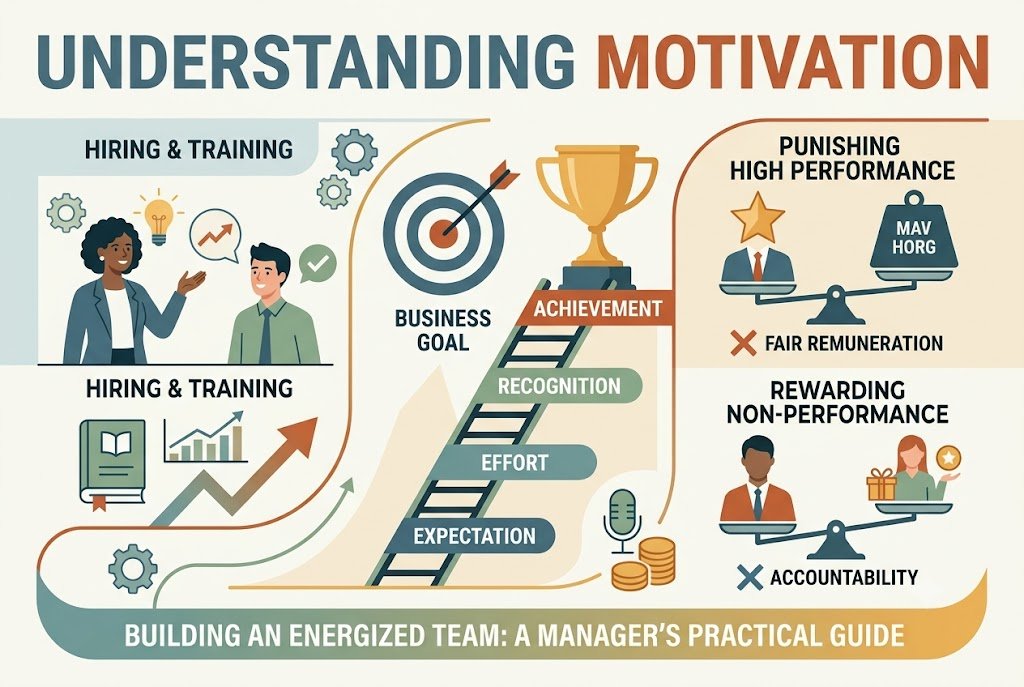
The keys identified above are: the setting of a target(s), a positive expectation, accomplishing the target(s), and possible recognition for the accomplishment. Understanding these elements will be crucial in establishing and maintaining an environment where people enjoy working and give you their best efforts.
One of the more helpful definitions of “motivation” is, “the act of, or anticipation of winning.” The antithesis is, “De-motivation is the act of or anticipation of losing.” Winning in this case is simply reaching a desired goal. If you think you can win something it keeps wind in your sail. The actual winning is icing on the cake. If you think you will lose it will be difficult, if not impossible, to fully apply yourself.
Let’s consider insights from a few other motivation theorists.
Abraham Maslow
Abraham Maslow introduced the “hierarchy of needs.” At the base are physical needs of air, water, food and security. Above that are the needs for socialization, success and self-fulfillment. To net these out in practical terms: do your employees receive a wage that allows them to buy groceries and pay the rent? Is your practice an enjoyable place to work? Does your staff receive any recognition for the work they do? Do they have the opportunity to utilize their native abilities in ways that are meaningful to them?
Frederick Herzberg’s
His research on work performance introduced a new concept, that of work satisfaction. His findings suggest that factors involved in producing work satisfaction (and motivation) are separate and distinct from factors that lead to work dissatisfaction. Furthermore, work “satisfiers” dealt with the nature and the content of the work itself; whereas work “dissatisfiers” dealt with the work environment. At the top of the “satisfier” list was achievement. This was followed by recognition. (We independently verified both of these by examining our own experiences) Humans have the ability to achieve, and through achievement experience psychological growth. They also have a strong need to avoid pain – i.e. a dissatisfying work environment. Does your practice provide the opportunity for employees to grow? Are there policy and/or environmental issues that make working at your practice dissatisfying?
Maxwell Maltz
He describes a “self-image psychology” where our subconscious mind records and stores the input it receives from our senses and the conscious mind. This includes the information we pick up from our environment, namely, the feedback we receive from others. What is the nature of the feedback your staff receives from you or others in the practice?
Maltz’s work also holds a key to self motivation. How you visualize and/or communicate with yourself has a profound impact on your self esteem and outcomes in life. If you prooject failure it will become a self fulfilling prophecy. If you think success you will be pleasantly surprised. If you want a motivated staff it’s important that you set a good example. Think positively.
A final thought comes from Greek Mythology – the Pygmalion Affect. This affect has been corroborated through research and here’s what it is: your staff will essentially live up to your expectations. If you think you have a competent staff they will behave in accordance with those expectations. If you think they are incompetent they will live up to that expectation. Be careful of what you expect.
Let’s put these pieces together in a practical approach to help you get the most out of your staff.
Hiring
Seek individuals that demonstrate a history of self initiative. Ask questions about the goals they’ve set and how they have overcome obstacles. The more self initiating, problem solvers you have on your staff the more dynamic and fruitful the work environment will be.
Training
Give employees the tools they need to succeed. Don’t assume anything. Show them how to win. Remember, motivation is the act of or anticipation of winning. Reward little successes with simple acknowledgements. Demonstrate that you believe in them.
Goal setting for the practice
This is often overlooked. It is important that people have targets to strive for. It is equally important to let the people that will be responsible for achieving the results to have some say in how the work should be done. Ask your employees for suggestions on how to run/improve the practice. You’ll be pleasantly surprised and you’ll fulfill an important need we all share, the need to grow and achieve.
Compensation
You get what you pay for. Provide a decent wage for your employees. You will attract and retain better talent. This in turn will create a more successful practice and a more enjoyable work environment.
Communication
Find things that are done right and express your appreciation. Identify problems that need to be solved and ask for input. Encourage people to act. Acknowledge their successes. Continually seek input from your staff.
Analyzing performance problems
If you are experiencing performance problems you may find the following diagnosis/prescription helpful.
Do you punish your performers?
As foolish as this idea initially seems, there’s a lot of truth to it. Typically, the person in a work group that gets the most work done is “rewarded” by getting additional work put on their plate. What a reward! More work! There’s nothing wrong with this as long as there is a commensurate change in remuneration. Unfortunately, that is rarely the case. So in essence we punish their performance by giving them additional work to complete. This can be particularly dissatisfying when coupled with the next issue – rewarding non-performance. Solution – pay for performance. Your star employees will take on as much as you want to give them provided they are fairly compensated. The additional wages you may pay for a star employee will be money well spent when you factor in the additional results you get from the efforts and the cost of turnover.
Do you reward non-performance?
Are there consequences to non-performance? If we have an underperforming employee that is not getting their work done we often provide them an “assistant”. The assistant is either you or one of your staff(usually a star). Our message to these employees is, “performance doesn’t matter.” You’d be surprised how “motivated” some people are to find just how little they have to do to keep their job. Solution – eliminate the reward. Hold them accountable for the work assigned. If they are incapable of doing the work assigned make sure that they have been adequately trained and examine if your expectations are realistic. If the training and your expectations are sound you may have a bad hire.
Are there obstacles to performance? Sometimes we inadvertently create bottlenecks or provide inadequate resources to accomplish a job. Solution – enlist the help (and brains) of those that will actually be responsible for doing the work. Try these two questions: “What is the biggest obstacle standing in the way of your performance? If it were up to you what would you do about it?” If there answer is not illegal, immoral, socially unacceptable and doesn’t break the budget you should probably let them try it.
Final thoughts
People work to provide for their basic needs of food and shelter. .People prefer work that is stimulating and provides them an opportunity to grow. We all appreciate recognition of our efforts. Hire talented people that want to grow. Give them the skills and resources they need to succeed. Provide them a fair and adequate wage. Enlist them in establishing targets for themselves and the practice. Provide ample recognition. A simple “Thank you” goes a long way.
